The Race to Save The Planet

This week, if you buy my new book on innovating to save the planet, I’ll donate the  proceeds to the Environmental Defense Fund.

The Infinite Resource: The Power of Ideas on a Finite PlanetFive years ago I decided that I needed to understand the state of the environment and my responsibilities as a human being.  I’d heard stories from all sides, but didn’t know the facts for myself.  So I dug into the primary research on climate change, fossil fuels, fresh water, forests, oceans, and more.  Along the way I found that most popular books on the topic gravitate towards extremes: either they claim that there is no problem at all, or they claim that the problem is so severe as to be insurmountable, or insurmountable without a profound reduction in human wealth.

The truth is more complicated.  The science is clear: we’re facing tremendous threats to the planet’s climate, environment, and the natural resources that we depend on.  Yet history is also full of examples of humanity overcoming natural resource shortages and reversing environmental damage.  We can do that, if we innovate fast enough.  Neither success nor failure is assured.  It’s up to us, in the science we fund, the laws we pass, and the decisions we make.

The end point of five years of research is a new book, The Infinite Resource: The Power of Ideas on a Finite Planet.   It is, to the best of my abilities, a balanced book – one that looks at the huge threats, the tremendous resources we can marshal against those threats, and the decisions we need to make.  The title reflects that our planet truly is finite, but that innovations can grow the total pie of resources, and even shrink our environmental footprint at the same time.

Steven Pinker has said that the book should be “required reading for all global thinkers and leaders.”  Readers have told me that they’ve found the book inspiring and eye opening and that it’s changed their minds on critical topics.

My primary goal is to reach people with it.  And so, if you buy the book through the link in this email, all proceeds from it will go to the Environmental Defense Fund.  I’ve chosen the EDF because they invest in and base their policies on sound science, and because they’ve been innovators in devising market-based solutions to environmental problems.  It was the EDF who proposed the solution that’s ended acid rain in North America – a ‘cap and trade’ system for the pollution that was causing acid rain.  That’s one of many stories in the book of innovations in our economic systems, which are just as important as innovations in technology.

Below you’ll find more about the book.  I hope you’ll take a look and, if you enjoy it, pass it on to friends, colleagues, and family.

Advance Praise for The Infinite Resource:

“This book contains a plan – probably the only plan – to save the world. Ramez Naam is unwilling to minimize the challenges that face us, but equally unwilling to sermonize or catastrophize. The Infinite Resource is an intelligent and responsible analysis, presented in lively prose; it should be required reading for all global thinkers and leaders. “
-          Steven Pinker, Harvard College Professor of Psychology, Harvard University, and the author of The Better Angels of Our Nature.

“Most books about the future are written by blinkered Pollyannas or hand-wringing Cassandras. Ramez Naam–Egypt-born, Illinois-raised, a major contributor to the computer revolution–is neither. Having thought about science, technology and the environment for decades, he has become that rarest of creatures: a clear-eyed optimist. Concise, informed and passionately argued, The Infinite Resource both acknowledges the very real dangers that lie ahead for the human enterprise and the equally real possibility that we might not only survive but thrive.”
-          Charles Mann, NYT best selling author of 1491 and 1493

“Brilliant. Ramez Naam shows that innovation is the only force equal to the global challenges that face us, and that we can prosper if we harness it.”
-          Ray Kurzweil, bestselling author of The Singularity is Near

“An amazing book. Throughout history, the most important source of new wealth has been new ideas. Naam shows how we can tap into and steer that force to overcome our current problems and help create a world of Abundance.”
-          Peter H. Diamandis, Chairman of the X PRIZE and Singularity University, Author of the NYT Best Seller Abundance – The Future is Better Than You Think

“A refreshingly thorough roadmap of solutions to our energy and climate crisis.”
-               UTNE Reader

“By providing a detailed, statistically rich historical background on many of the detrimental practices and attitudes that have brought humanity to the nail-biting precipice that may await a century from now, Naam strengthens his soberly confident, if not cautiously optimistic, predictions for how humans can walk it back from the edge of disaster.”
-              Booklist


The Infinite Resource: The Power of Ideas on a Finite Planet

Climate Change. Finite Fossil Fuels. Fresh Water Depletion. Ocean Acidification. Overpopulation. Deforestation. Feeding the World’s Billions. Rising Commodity Prices.

We’re beset by an array of natural resource and environmental challenges. They pose a tremendous risk to human prosperity, to world peace, and to the planet itself.

Yet, if we act, these problems are addressable.  For the most valuable resource on earth is not oil, gold, water or land. Instead, our capacity for expanding human knowledge is our greatest resource, and the key to overcoming the very real resource scarcity and enormous environmental challenges we face.

Throughout human history we have learned to overcome scarcity and adversity through the application of innovation — the only resource that is expanded, not depleted, the more we use it.

The century ahead is a race between our damaging overconsumption and our growing understanding of ways to capture and utilize abundant natural resources with less impact on the planet. The Infinite Resource is a clear-eyed, visionary, and hopeful argument for progress.

Posted in Uncategorized | Leave a comment

The Evidence on GMO Safety

I was on the Melissa Harris-Perry show today, speaking about GMOs.  You can see the video at the show’s website or embedded below.

Visit NBCNews.com for breaking news, world news, and news about the economy

First, a statement on my interests:  I have no relationship whatsoever with Monsanto or any other ag or biotech company.  I hold no Monsanto stock. I get no money from them.  Nothing of the sort.  My only interest is in advancing public knowledge of a technology that’s widely misunderstood and which, when well-managed, can benefit both humanity and the planet.  All the research I presented was research I did when writing my book on innovating to save the planet, The Infinite Resource: The Power of Ideas on a Finite Planet.

I do believe that we’ll eventually have labels on genetically modified foods.  So long as those labels are in the ingredients section and not needlessly frightening, I think that’s fine.  Clearly a set of people very much want labels, and the resistance to labeling gives the appearance that there’s something to hide with genetically modified foods. There isn’t. Genetically modified foods are safe.

Because there wasn’t enough time to go into detail on the show, I want to link to statements from the world’s most respected scientific bodies and journals on the topic of GMO safety. Here’s what they say.

The US National Academy of Sciences

This is the premier scientific body in the United States.  They have repeatedly found genetically modified food safe, noting that after billions of meals served, “no adverse health effects attributed to genetic engineering have been documented in the human population.”

They’ve also found that genetically engineered crops are kinder to the environment than non-genetically engineered crops.  The National Academy of Science’s 2010 report, Impact of Genetically Engineered Crops on Farm Sustainability in the United States, found that GM crops planted to date had reduced insecticide use, reduced use of the most dangerous herbicides, increased the frequency of conservation tillage and no-till farming, reduced carbon emissions, reduced soil runoffs, and improved soil quality. The report said that, “Generally, GE (GMO) crops have had fewer adverse effects on the environment than non-GE crops produced conventionally.”

The American Association for the Advancement of Science

This is the largest organization made up of professional scientists in the United States, and also publisher of Science magazine, one of the two most respected scientific journals in the world.  The AAAS says “The science is quite clear: crop improvement by the modern molecular techniques of biotechnology is safe.”

The American Medical Association

The premier body of physicians in the United States.  They have consistently found genetically modified foods as safe to eat as any other food, stating “there is no scientific justification for special labeling of genetically modified foods”.

The European Commission

Europe is extremely anti-GMO.  But even there, the scientific community is clear that genetically modified foods are safe.  The scientific advisor to the European Comission has said “there is no more risk in eating GMO food than eating conventionally farmed food”.

The European Commission’s 2010 report on genetically engineered food (based on independent research not funded by any biotech company) said: “The main conclusion to be drawn from the efforts of more than 130 research projects, covering a period of more than 25 years of research, and involving more than 500 independent research groups, is that biotechnology, and in particular GMOs, are not per se more risky than e.g. conventional plant breeding technologies.”

Royal Society of Medicine

England’s top medical society, the equivalent of the United State’s American Medical Association, published a review of all the information about genetically modified foods that concluded, “Foods derived from GM crops have been consumed by hundreds of millions of people across the world for more than 15 years, with no reported ill effects (or legal cases related to human health), despite many of the consumers coming from that most litigious of countries, the USA.”

The French Supreme Court

The French Supreme Court isn’t a scientific body, but I mention them here because their recent decision was so remarkable.  France is a very anti-GMO country.  Yet the French Supreme Court struck down France’s GMO ban, ruling that the government had shown no credible evidence of any harm to humans or the environment.  You can read about that here.

A Few, Widely Reported, Non-Credible Studies

Thus far there have been several hundred studies on the safety of genetically engineered food.  All but a handful have found them completely safe.  The only studies that have found that genetically modified foods harm animals (the ones quoted as saying that they cause cancer and infertility) all come from one laboratory, that of Giles Eric Seralini in France.

Yet Seralini’s studies have been widely debunked.

And even food advocates find them hard to believe.  My fellow guest on MSNBC, food policy advocate (and GMO labeling proponent) Marion Nestle, herself has said that she finds them hard to believe.  Marion Nestle writes:

These results are so graphically shocking (see the paper’s photographs), and so discrepant from previous studies (see recent review in the same journal), that they bring out my skeptical tendencies.  (Note: Although Séralini is apparently a well known opponent of GMOs, his study—and that of the review—were funded by government or other independent agencies.)  … the study is weirdly complicated.

http://www.foodpolitics.com/2012/09/what-to-make-of-the-scary-gmo-study/

And respectable scientists writing in the journal Nature (the other most respected scientific journal in the world, along with Science) found numerous problems with the GMO-rat-cancer study.  Among other things, Seralini (the scientist claiming that GMOs cause cancer) refused to let science journalists see the paper ahead of the press release, have found something that other researchers doing very similar studies have never found, and have refused to share the actual data of their experiments.

A Scientific Consensus

All together, the scientific consensus around the safety of genetically modified foods is as strong as the scientific consensus around climate change.  These foods have been studied more than any other, and everything tells us that they’re safe.

Posted in Uncategorized | Comments Off

FREE Copy of Nexus for Worldcon Attendees

Buy NexusIf you attended Worldcon 2012 (Chicon) or are registered for Worldcon 2013 (LoneStarCon) or Worldcon 2014 (LonCon), I will send you a FREE electronic copy of Nexus.

Just drop me an email to get it.

If you read it and love it, I hope you’ll consider nominating Nexus for the Hugo Award for Best Novel or nominating me for the Campbell Award for Best New Writer.  But either way, the book is yours, and what you do with it is up to you!

(Each copy will be bought and paid for by yours truly. I am, in effect, buying you the book as a gift.)

Is Nexus worth your time?

Well, here’s what others have to say about Nexus:

Wired says “Good. Scary good… stop reading now and have a great time reading a bleeding edge technical thriller that is full of surprises.”  read the whole thing

Cory Doctorow at BoingBoing says “Nexus is a superbly plotted high tension technothriller… full of delicious moral ambiguity… a hell of a read.”  read the whole thing

The Wall Street Journal says “Provocative… a double-edged vision of the post-human.” read the whole thing

Alastair Reynolds, author of Revelation Spacesays “Gripping near future speculation… All the grit and pace of the Bourne films.”

Ars Technica says “Nexus is a lightning bolt of a novel… with a sense of awe missing from a lot of current fiction.” read the whole thing

Booklist says “Starred Review. Naam turns in a stellar performance with his debut SF novel… What matters here is the remarkable scope of the story and its narrative power.” read the whole thing

Why am I doing this?

Nomination seasons for the Hugo Awards and the Campbell Award are here. And the nominations are made by Worldcon attendees.  Because Nexus came out at the very very end of 2012 (December 18th), fewer people will have run across it in the natural course of things than for a book that was published in the beginning or middle of 2012. This offer is intended to balance that out.

You can nominate up to 5 works in each category.  Think of this not as your final vote, but as your assertion that a book or an author is worth consideration.  Your nominations are due by March 10th.  The electronic ballot is here.

If you read it, will you nominate it for the Hugo or me for the Campbell?  That’s entirely to you! Whether you do or don’t, I’ll be delighted that you took the time to read it.

Drop me an email and I’ll buy you a copy, absolutely no strings attached.

Who I’m Considering Nominating

I don’t think it’s fair to only promote my own work when there are so many other great writers and books out there.  I’m behind on my own reading, but plan to catch up in February, before the March 10th deadline for nominations.   That said, as of right now, books and authors I’m considering nominating:

For Best Novel:

  1. The Fractal Prince by Hannu Rajaniemi – Rajaniemi’s second novel is even better than his debut, The Quantum Thief.  Incredibly original worldbuilding, fun characters, fast pace, and interesting speculation on a truly post-Singularity world.
  2. 2312 by Kim Stanley Robinson – Stan Robinson has created an incredible thoughtful, philosophical work that explores geo-engineering, human sexuality, economics, consciousness, and AI.  It’s a book to be savored rather than rushed through, and with ideas that have stuck with me since I read it.

For Campbell Award For Best New Author

  1. Hannu Rajaniemi tops my list.

What Else I Plan to Read Before Nominating

As I said, I’m behind on my reading.  At the top of my list of books that came out in 2012 which I must soon read (many of which may be strong contenders for the Hugo or their authors for the Campbell) are:

  1. vN by Madeline Ashby (a debut novel, which also makes Madeline eligible for the Campbell)
  2. Throne of the Crescent Moon by Saladin Ahmed
  3. Blue Remembered Earth by Alastair Reynolds
  4. The Hydrogen Sonata by Iain M. Banks
  5. Alif the Unseen by G. Willow Wilson

I’ll update my thoughts on nominees after I’ve read all of these (and hopefully more).


Posted in Uncategorized | 1 Comment

Awesome Press for NEXUS – Here’s a Roundup

Buy NexusWow.  It’s been an awesome few days.  I’ve been reading people calling Nexus “Good. Scary good.”, “hell of a read”, “superb”, “brilliant”.   Wow!

The response to Nexus has been totally amazing.  I’m thrilled and honored!  Because I’m having a hard time keeping track myself, here’s a roundup of all the amazing reviews, articles, interviews, and podcasts from BoingBoing, ArsTechnica, IO9, Wired, SFSignal, HumanityPlus, IEET, and more.

Reviews

Wired says “Good. Scary good… stop reading now and have a great time reading a bleeding edge technical thriller that is full of surprises.”  read the whole thing

Cory Doctorow at BoingBoing says “Nexus is a superbly plotted high tension technothriller… full of delicious moral ambiguity… a hell of a read.”  read the whole thing

The Wall Street Journal says “Provocative… a double-edged vision of the post-human.” read the whole thing

Ars Technica says “Nexus is a lightning bolt of a novel… with a sense of awe missing from a lot of current fiction.” read the whole thing

Booklist says “Starred Review. Naam turns in a stellar performance with his debut SF novel… What matters here is the remarkable scope of the story and its narrative power.” read the whole thing

Publisher’s Weekly says “Mesmerizing”.

SFX Magazine says “Naam displays a Michael Crichton-like ability to explain cutting-edge research via the medium of an airport techno-thriller.”

Ben Goertzel at HPlus Magazine says “speculative yet impressively plausible… Nexus, as well as being a fun read, has something to contribute to the dialogue that humanity is now having with itself” read the whole thing

WTF Are You Reading? says “the perfect blend of “The Matrix” and “War Games”… I would recommend this book to  anyone who has ever sat in from of the glow of their computer screen and wondered “what if”…” read the whole thing

Katherine McCarthy at the IEET says “If it isn’t the cinematic handling of some very futuristic images or the curious immersion of cybernetic pondering into the narrative flow; Ramez Naam’s Nexus will impress a reader” read the whole thing

PageOfReviews says “Nexus is a fascinating study into how technology might inform human evolution. At times it is also a scathing commentary on the United States’ “War on Drugs” and “War on Terror”.read the whole thing

Timothy Ward says “Ramez writes excellent action sequences, incorporating his technology well, and the lives at stake are more than just cardboard cutouts. No one in this story is “as meets the eye,’” read the whole thing

Trevor Hogg at Flickering Myth says ““Naam has a visual style with his words which leads to one experiencing cinematic scenes rather than being swamped with textbook exposition.” read the whole thing

Bookworm Dreams says “Five Stars. Nexus by Ramez Naam reminds me of my favorite science fiction authors: Cory Doctorowwith dystopia/government conspiracy theme, Michael Crichton with unexpected twists and action/adventure, Arthur C. Clarke because everything Ramez Naam described has a scientific background.” read the whole thing

Interviews and Podcasts

GeekWire featured me in an interview as their Geek of the Week

Brenda Cooper interviews me at SFSignal

Kristin Centorcelli interviews me at My Bookish Ways

I’m on Cesar Torres’s podcast, The Labrynth

I’m on Timothy C. Ward’s podcast, AudioTim

Articles

I have a guest post at SFSignal on The Science of Nexus (adapted from an essay at the end of the book)

I have a longer article, with videos and links, at IO9 - Re-Wiring the Brain: The Science of Nexus

And last but definitely not least, over at John Scalzi’s Whatever blog, I have a piece about The Big Idea behind Nexus.

And there’s more to come!

Posted in Uncategorized | 1 Comment

Nexus is Here!

NexusAwesome reviews are coming in today for Nexus:

Wired says “Good. Scary good… stop reading now and have a great time reading a bleeding edge technical thriller that is full of surprises.”  read the whole thing

Cory Doctorow at BoingBoing says “Nexus is a superbly plotted high tension technothriller… full of delicious moral ambiguity… a hell of a read.”  read the whole thing

Ars Technica says “Nexus is a lightning bolt of a novel… with a sense of awe missing from a lot of current fiction.” read the whole thing

More to come…

or Barnes and Noble

Posted in Uncategorized | Comments Off

Nexus: T Minus 7 Days


Buy NexusNexus 
comes out in 7 days.  The early reviews are coming in, and so far people seem to like it.  Quotes from three of my favorites so far:

“A superbly plotted high-tension technothriller … full of delicious, thoughtful moral ambiguity … a hell of a read.” – Cory Doctorow, BoingBoing 

“Naam displays a Michael Crichton-like ability to explain cutting-edge research via the medium of an airport techno-thriller.” - SFX Magazine

“A rich cast of characters… The action scenes are crisp, the glimpses of future tech and culture are mesmerizing.” - Publisher’s Weekly

And more about the book:

Who decides what you can put in your brain? Who draws the line between human and non-human? How do we choose between liberty and security?

In a near future scarred by the mis-use of advanced technologies, government agencies and international treaties use extraordinary powers to suppress research that could lead to new horrors. In this world, the experimental and illegal nano-drug Nexus can link humans together, wirelessly connecting brain to brain. There are some who want to improve Nexus. There are some who want to eradicate it. And there are others who just want to exploit it.

When a young and idealistic American scientist named Kade is caught improving Nexus, he’s blackmailed into spying on an eminent Chinese researcher who may or may not be weaponizing Nexus – turning it into a tool for coercion and political assassination. Bit by bit, Kade is thrust over his head into a world of danger and international espionage – with more at stake than anyone realizes.

From the halls of academe to the halls of power; from the headquarters of an elite US agency in Washington DC to a secret lab beneath a top university in Shanghai; from the underground parties of San Francisco to the illegal biotech markets of Bangkok; from an international neuroscience conference to a remote Buddhist monastery in the mountains of Thailand – Nexus is an exploration of the next step in human evolution, a scathing critique of the US War on Drugs and War on Terror, and a thrill ride through a world on the brink of explosion.

Coming December 18th 2012

“the most brilliant hard SF thriller I’ve read in years. It’s smart, it’s gripping, and it describes a chilling reality that is all-too-plausible… Reminds me of Michael Crichton at his best.”  - Brenda Cooper, author of The Silver Ship and the Sea and The Creative Fire

“a gripping piece of near future speculation, riffing on the latest developments in cognition enhancement. With all the grit and pace of the Bourne films, this is a clever and confident debut by a writer expertly placed to speculate about where we’re heading. Unlike a lot of SF, this novel dares to look the future square in the eye.” - Alastair Reynolds, bestselling author of Revelation Space and Blue Remembered Earth

”Any old writer can take you on a roller coaster ride, but it takes a wizard like Ramez Naam to take you on the same ride while he builds the roller coaster a few feet in front of your plummeting car…  you want to read it now before everyone’s talking about it.” -  John Barnes, author of Mother of Storms and the Daybreak series

“From the very first page, Nexus grabs you roughly by the scruff of the neck and screams right into your face… One of the most intensely compelling and original debut novels I’ve read in a very, very long time. His breathtaking expertise and confidence as a writer makes Naam the only serious successor to Michael Crichton working in the future history genre today.” – Scott Harrison, author of Archangel

“A dazzlingly clever and well informed near-future extrapolation, and also an outrageously exciting and cinematic shoot ‘n punch ‘em up. A ‘smart thriller’ in all senses of that phrase. Ramez Naam really does know how to make you turn that page.” - Philip Palmer, author of Version 43

“An incredibly imaginative, action-packed intellectual romp! Ramez Naam has turned the notion of human liberty and freedom on its head by forcing the question: Technology permitting, should we be free to radically alter our physiological and mental states?” - Dani Kollin, Prometheus award winning author of The Unincorporated Man

Pre-Order Nexus and get More Than Human free! Find out more!


Posted in Uncategorized | Comments Off

Announcing The Infinite Resource: The Power of Ideas on a Finite Planet

I’m pleased to announce my upcoming book, The Infinite Resource: The Power of Ideas on a Finite Planet.

The book comes out in March 2013 from University Press of New England.

The book ranges far and wide over the natural resource and environmental challenges we face today (finite fossil fuels, fresh water depletion, ocean overfishing, deforestation, and especially climate change), the times and ways that we’ve overcome such issues in the past,  the technological and scientific frontiers that could help us do so again (solar, wind, biofuels, energy storage, fish farms, high yield agriculture, even some climate engineering) and what we need to change in order to encourage innovation in those areas (education, our handling of the commons, and the economic incentives to innovation and efficiency vs. consumption).

Coming March 2013

From University Press of New England

The Infinite Resource: The Power of Ideas on a Finite Planet

“Brilliant. Ramez Naam shows that innovation is the only force equal to the global challenges that face us, and that we can prosper if we harness it.”
-          Ray Kurzweil, bestselling author of The Singularity is Near

“An amazing book. Throughout history, the most important source of new wealth has been new ideas. Naam shows how we can tap into and steer that force to overcome our current problems and help create a world of Abundance.”
-          Peter H. Diamandis, Chairman of the X PRIZE and Singularity University, Author of the NYT Best Seller Abundance – The Future is Better Than You Think

“This book contains a plan – probably the only plan – to save the world. Ramez Naam is unwilling to minimize the challenges that face us, but equally unwilling to sermonize or catastrophize. The Infinite Resourceis an intelligent and responsible analysis, presented in lively prose; it should be required reading for all global thinkers and leaders. “
-          Steven Pinker, Harvard College Professor of Psychology, Harvard University, and the author of The Better Angels of Our Nature.

“Most books about the future are written by blinkered Pollyannas or hand-wringing Cassandras. Ramez Naam–Egypt-born, Illinois-raised, a major contributor to the computer revolution–is neither. Having thought about science, technology and the environment for decades, he has become that rarest of creatures: a clear-eyed optimist. Concise, informed and passionately argued, The Infinite Resource both acknowledges the very real dangers that lie ahead for the human enterprise and the equally real possibility that we might not only survive but thrive.”
-          Charles Mann, NYT best selling author of 1491 and 1493

The most valuable resource on earth is not oil, gold, water or land. Instead, our capacity for expanding human knowledge is our greatest resource, and the key to overcoming the very real resource scarcity and enormous environmental challenges we face. Throughout human history we have learned to overcome scarcity and adversity through the application of innovation — the only resource that is expanded, not depleted, the more we use it.

The century ahead is a race between our damaging overconsumption and our growing understanding of ways to capture and utilize abundant natural resources with less impact on the planet. The Infinite Resource is a clear-eyed, visionary, and hopeful argument for progress.

If you want to understand the challenges of climate change, finite fossil fuels, fresh water depletion, feeding the planet, and more – and if you want to understand how to overcome those challenges through innovation – read this book.

Table of Contents

Part 1 – Best of Times, Worst of Times

1 – The Best of Times: The Rise of Innovation

The last 500 years have seen a surge in human innovation, driven by increased ability of ideas to spread from person to person, by increased competition between ideas, and by increased rewards for inventors. Across this period, cultures that held on to rigid top-down structures or which restricted communication – including China, Japan, and the Muslim world – stagnated, while the messy, chaotic, highly competitive world of Europe saw a huge burst in invention.

2 – The Best of Times: The Incredible Present

That explosion of innovation has led to our incredible present. Humans today are the longest lived, healthiest, free-est, best fed, least poor, least likely to be starving, most able to communicate and access information of any time in history.  Chapter 2 presents the staggering numbers of how well off we are today in comparison to any previous time in history, while laying out how far we have to go before wealth, health, and freedom are universal.

3 – The Worst of Times: Running Out of Steam

Energy shortages have doomed societies in the past. Today, our most used energy sources are fossil fuels. The most vital of those is oil. And the era of easy oil is drawing to a close.

4 – The Worst of Times: Peak Everything

Energy is not the only resource challenge we have.  In the next 40 years the world will need to increase food production by 70% just to keep up with demand. At the same time, fresh water sources are rapidly being depleted, tropical forests continue to be chopped down, almost all fish species that humans hunt in the oceans are overtaxed, and the prices of commodities of all sorts have soared as supply has failed to keep pace with demand.

5 – The Worst of Times: Greenhouse Earth

In 1896, Nobel prize-winner Svante Arrhenius predicted that CO2 emissions would eventually warm the Earth. Now that is happening. Glaciers are melting. The Arctic ice cap is dwindling. Extreme heat, drought, flooding, and fires are becoming more common. And every degree the planet warms increases the risk of the release of even more greenhouse gas. Climate is a challenge that exacerbates all others. It may be the largest test we’ve ever faced as a species.

6 – End of the Party?

In the face of our environmental and natural resource challenges, a common refrain is that economic growth is the driver of our problems, and that growth must end.  Yet the world houses billions who have never had the luxury of easy transportation, of readily available heating and cooling, of even electricity and refrigeration.  The world’s rising poor badly want the luxuries that westerners take for granted.  The only way out of our problem is not to attempt to end growth – but to innovate to grow the pie of resources available and shrink the negative impacts that wealth and prosperity have on the planet.

Part 2: The Power of Ideas

7 – The First Energy Technology

Over the last 10,000 years, humans have continually innovated in harvesting food from the land. While hunter gatherers needed an average of 3,000 acres to feed one person, modern farming uses just 1/3 of one acre to feed one person.  We’ve increased the productivity of the land by a factor of 10,000 – all of it through innovation.

In this light, our planet’s carrying capacity isn’t a fixed number. It’s a factor of population, of consumption, and of how effectively we can produce food and other resources we need. If we can continue to increase the amount of food grown per acre – in sustainable ways – we can meet the needs of a growing and increasingly wealthy population.

8 – The Transformer

Ideas are transformers of matter. They turn dumb, inanimate objects into useful things. The component metals and plastics in an iPhone are worth pennies, but properly put together with the right knowledge, their worth is far vaster. Throughout history we’ve produced new ideas – new recipes and designs – that have transformed matter into new forms that serve us – steel, plastics, carbon composites, and more on the way.  The apparent possibility space of new recipes for matter is far from exhausted – it seems to be growing larger at every step.

9 – The Substitute

We’ve faced resource scarcities before.  In the 19th century, we nearly drove sperm whales into extinction harvesting them for their whale oil. Agriculture in Europe and the United States faced the exhaustion of the guano deposits that provided fertilizer, and then decades later of the saltpeter deposits that replaced them. In World War II, the allies lost the rubber plantations of South East Asia to the Axis powers.

In every case, we’ve rallied, and innovated to find substitutes for those scarce resources – kerosene for lighting, synthetic fertilizer harvested from the abundant nitrogen in the atmosphere, synthetic rubber made from carbon.  Knowledge is the ultimate substitute for finite resources.

10 – The Reducer

Ideas can also reduce resource use.  We use 1/10,000th as much land to produce food for one person as we once did.  It takes 1/50th as much energy to produce a ton of steel as it did in the 1800s.  Refrigerators use 1/4 the energy they did in the 1970s. Jet airliners use 1/3 the fuel per passenger mile that they did in the 1970s. LEDs use 1/500th the amount of energy per unit of light as candles.

Most of those gains have been driven by the market. Yet sometimes, the market fails. It failed to reduce pollution on its own. And so in the 1970s, the US created the EPA, the Clean Water Act and the Clean Air Act, creating incentives that bolstered and complemented the market mechanisms already at work.  Driven by those regulations, emissions of acid-rain causing sulfur dioxide are down by half since the 1980s, emissions of carbon monoxide are down by half since the 1970s, emissions of lead have dropped to nearly zero, emissions of ozone-destroying CFCs are down to nearly zero.

All of that has happened while the US economy has nearly tripled in size since 1970.

Innovation – new ideas – can reduce both resource use and pollution, when the right incentives exist.

11 – The Recycler

Knowledge can also turn waste or poison back into value.  Since 1970, the amount of energy required to desalinate one gallon of water has dropped by nearly a factor of 10.  Desalination plants now sell water they produce at 5 gallons per penny.  Simultaneously, entrepreneurs and governments are ramping up plans to turn waste into energy, and to mine landfills for the estimated 10-15 year global supplies of gold, steel, aluminum, and rare earth metals that they contain.

We think of our planet as finite. Yet finiteness means that raw materials are seldom destroyed. They’re redistributed, from the ores they were mined from to cities, factories, and landfills.  With energy and innovation, raw materials can be put back into circulation nearly indefinitely.

12 – The Multiplier

Innovation is also the ultimate multiplier on the resources we can safely and sustainably capture. Of all physical resources, the most useful is energy. And the Earth is bathed in energy. The sun strikes the planet with 10,000 times as much energy as humanity uses from all sources, combined. In one hour, the amount of energy striking the planet from the sun is as large as humanity’s total energy use for one year.  The challenge is capturing that energy and storing it away.

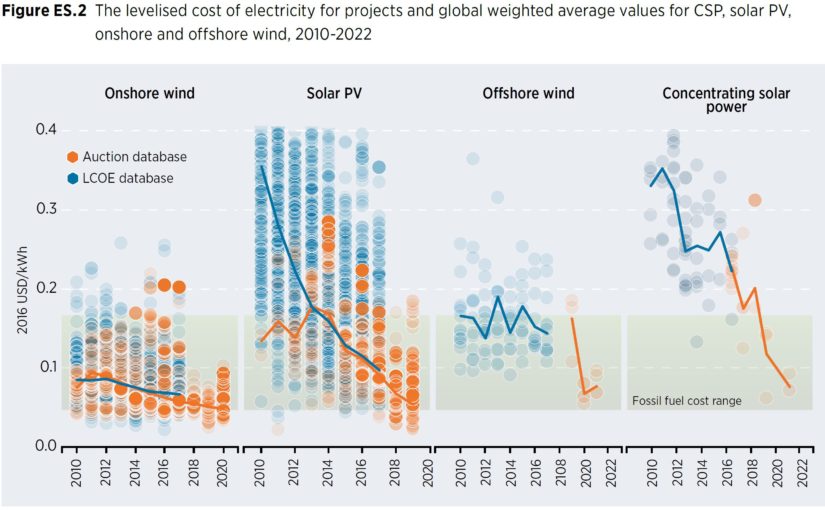
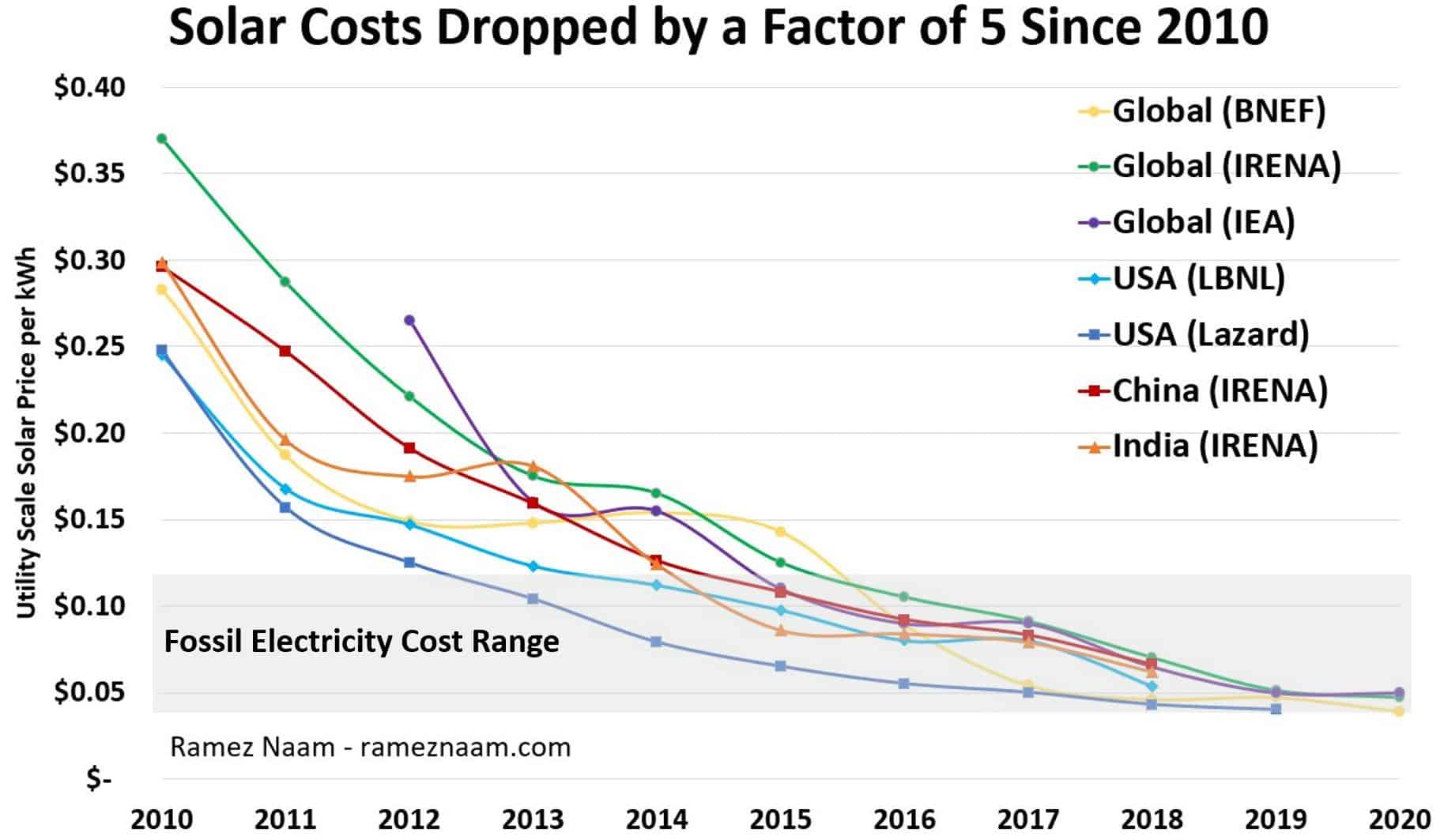
On that front, the pace of innovation is incredible. Since 1980, the price of solar panels has dropped by a factor of more than 20, and continues to plunge exponential. The price of batteries and energy storage plunged has plunged by a factor of 10 since 1990.  If we can continue this pace of innovation – and overcome numerous technical hurdles in the way – we’ll have access to plentiful energy – more than enough to provide every person on Earth more energy than a typical American uses today – and at a price that is far lower than we pay now.

Part 3: Unleashing Innovation

While the Earth’s natural resources are vast, and while innovation has overcome tremendous problems in the past, our current challenges remain severe. We cannot rest idly by and hope that innovation will solve our problems.  Instead, we should act to unleash innovation: by investing in people, by fixing the market failures that distort both innovation and consumption, and by embracing new innovations that could be vital to us, but which we now fear.

13 – Innovation Nation

Americans think of themselves as a nation of innovation. Yet our spending doesn’t reflect that. We spend 200 times more on energy consumption than on energy R&D. We spend 60 times more on oil imports alone than we do on clean energy R&D of all sorts.

Americans think of themselves as a highly educated nation, yet our education system lags that of other countries, and is structured more like the top-down world of Middle Ages China than the messy, bottoms-up, highly competitive landscape of Renaissance Europe.

If we want to increase our pace of innovation, we need to invest in the long lead R&D that can pay dividends, and need to reform our educational system to tap into the incredible power of diversity, experimentation, and competition.

14 – The Flaw in the Market

The open market is the operating system for the world. It directs the flow of resources, people, and attention. It has been more successful than any other system in creating wealth and alleviating poverty. Yet it has a massive flaw in dealing with resources that are un-owned, un-priced, and of value to everyone. These are the global commons – our air, our seas, and in some cases our rivers. Because the market treats them as being of zero value, it encourages their degradation. If we want to preserve our planet, we need to reform our market to value the planet.

15 – Market Solutions

How would we fix the market? The key is to place a price on activities that damage the commons. The idea of market based solutions – first enacted by Republicans – has already proven itself successful in reducing acid rain and in halting the damage to the ozone layer. In both case, it’s done so at far lower cost than even the advocates of these policies expected.

Pollution taxes – and most importantly, a carbon tax – don’t need to be economic drains. They can be revenue neutral: for every dollar raised in a pollution tax, a dollar is taken off the payroll and income tax bills of Americans. In this way, the tax code shifts to tax more of the bad (pollution) and less of the good (income).  This is an inherently pro-market approach, that takes advantage of the incredible power of markets, and stops the treatment of our global commons as essentially socialist resources.

16 – The Unthinkable: Here There Be Dragons

To maximize the power of innovation, we need to be willing to embrace innovations that offer us value, even when they tap into our fears.  One of those is nuclear power. While solar power and energy storage on a path to eventually being cheaper than any other energy solution, we are still decades away from that point. Nuclear power is nearly carbon free and can provide overnight ‘baseload’ power when solar is least effective.  Nuclear is perhaps the most hated and feared technology among environmentalists.  Yet the numbers show that coal plants kill thousands of times more people than nuclear plants, release more radiation into the environment, and have a more adverse effect on both humanity and the planet.

17 – The Unthinkable: Climate Engineering

Try as we might, we are currently not on path to keep CO2 concentrations in the atmosphere below dangerous levels. It’s clear that there is abundant green energy to power our economy, but the long transition period between our current fossil-fuel based economy to one based primarily on solar energy will almost certainly put us into dangerous territory. We’d be irresponsible if we didn’t pursue fall-backs and contingency plans for that situation.

The ultimate contingency plan is the engineering of the planet’s climate. Climate engineering, today, is more science fiction than science fact. We’ve seen that volcanic eruptions can lower the planet’s temperature. We’ve calculated that we can extract CO2 from the atmosphere and store it away safely underground. Yet actual research into both approaches has been minimal.  Climate engineering is not an excuse to avoid the hard work of switching over to a clean energy, high efficiency economy. But it is a set of tools we’d rather have and not use, than need and not have. To be prudent, we need to invest heavily in R&D in climate engineering today, to be ready to use it if the future situation demands it.

18 – The Unthinkable: Greener Than Green

The greatest environmental impact humans have today is through agriculture. We use 1/3 of the Earth’s land area to grow food. Agriculture is the prime driver of deforestation and the prime driver of species loss. At the same time, to feed the planet, we need to increase food production by 70% by 2050. There is no room left to increase the amount of land we use to grow food.  We need to make this increase on the land we are currently using.  And, at the same time, we’d ideally make our food more nutritious, reduce nitrogen runoff into the oceans, reduce pesticide use, and reduce fossil fuel use.

The key enabling technology to all of these goals may be genetically modified foods. Carefully used, GMOs show the promise to increase nutrition, reduce tillage, reduce nitrogen runoffs, reduce pesticide use and pesticide poisoning, and increase the amount of food grown on the same amount of land. The next generation of GMOs show promise in addressing vitamin A deficiency and iron deficiency, in growing in drought and salt water, in dramatically increasing the yield of common foods, and even in fertilizing themselves from the abundant nitrogen in the atmosphere. And that generation is being developed, in large part, by non-profit foundations and universities, with a promise to give the technology away for free in the developing world.  Carefully used, GMOs can be an incredible boon to both human health and the natural world.

19 – The Decoupler

The last chapters of the book turn to the long view.  What is economic growth? Is the growth of wealth always tied to the growth of consumption?

No. Since 1970, GDP per person on Earth has roughly doubled. Nutrition has increased. Poverty has decreased. Living space per person has increased. Yet CO2 emissions per capita have remained largely unchanged.

In the developed nations of the North America, Europe, and Japan, a new trend is shaping up. CO2 emissions per capita are declining slightly. Water use per capita is declining rapidly. Deforestation has ended, and forests are growing in both Europe and North American.  Pollution levels are markedly down.   Knowledge is the ultimate decoupler – it can decouple wealth from consumption and pollution.  If we invest in innovation correctly we can have far more wealth, with far less impact on the planet.

20 – Of Mouths and Minds

Are human beings primarily mouths? Or primarily minds? Overpopulation has driven a tremendous host of environmental ills.  Yet people have also been the source of all the art and culture we benefit from, and all the inventions that make our lives longer and more comfortable. Evidence shows that people in higher densities – in cities and in more populous nations – innovate more per person. A larger population, surprisingly, may produce innovation at a faster rate than it produces consumption.

Population is not a matter to be taken lightly. It is soaring most rapidly in the poorest countries of the world – and there we should continue to help those nations grow in wealth and education and reduce their population growth rates.  But in the rest of the world, where population decline is looming as a possibility, we may very well want to take steps to boost our fertility, to at least maintain the planet’s population, so all of us can benefit from the ideas produced by others.

21 – Easy Way, Hard Way

In the end, there are two ways forward through the challenges of the 21st century. If we do not act, we’re setting ourselves up for the hard way – a path where increasing environmental damage and resource limits cause problems, and where we’re forced into a reactive move. If we act proactively, we’re setting ourselves up for the easy way – one where we take steps now to get ahead of the problems that face us, and set ourselves up for even more prosperity in the future, at a lower cost to the planet than ever before.

Chapter 21 closes the book with a call to action, and a list of steps readers can take.

Easy way or hard way, the choice is ours.

Posted in Uncategorized | Comments Off

China’s Tipping Point on Environment?

Chinese environmental protesters have won the cancellation of an industrial waste pipeline that would have dumped waste from a paper factory into the ocean near the town of Qidong.

This is not the first such victory.  The Guardian notes that:

The protest followed similar demonstrations against projects in the Sichuan town of Shifang earlier this month and in the cities of Dalian in the north-east and Haimen in southern Guangdong province in the past year.

There’s a general pattern in concern around the environment. (And a very similar one in concern for civil liberties.)  When people are desperately poor, their concerns are food, shelter, energy, and physical safety.

As people grow richer and are able to meet their basic needs, environmental quality and civil liberties, which were once considered niceties, rise in importance.

In regard to environmental quality, this is known as the Environmental Kuznets Curve:

h

As countries grow richer, their levels of environmental degradation rise at first, then level, then drop. This isn’t uniform across all types of pollution.  For instance, the US has already peaked and now sharply declined in the emission of lead, carbon monoxide, sulfur dioxide (which causes acid rain), and CFCs (which degrade the ozone layer).  But for CO2 emissions, the US is in that middle zone.

China has been over on the left, rapidly industrializing.  But now it appears to be heading into that middle zone, as there’s increasing pressure to cancel polluting projects, to improve air quality, to reduce emissions of pollutants like sulfur dioxide.

What we’re seeing is the emergence of a Chinese environmental movement, something that’s only become possible because China’s people are rich enough that preserving the environment has become important to them.

This is still the beginning. China is a major polluter. There are years, if not decades, of work ahead. But it’s heartening to see Chinese people standing up against pollution, and in many cases, succeeding.

Perhaps we’ll see the same transition on civil liberties one day.

Posted in Uncategorized | Tagged , , , | Comments Off

Pricing Nature to Save the Planet

New Scientist, covering Rio+20, talks about putting a price on the natural world:

Green economics, the theory goes, will work by quantifying nature and giving it a cash value. As Steiner put it: “Factoring natural capital into the bottom line will bring the real wealth of the planet from the invisible to the visible spectrum.” The hope is that, faced with the potential for monetary loss as a result of environmental degradation, decision-makers will feel compelled to act.

The notion of putting a price tag on nature is a powerful one. Economic self interest is a tremendous force. Given the importance of the planet to us, why isn’t it as easy to strike it rich in green tech as it is in internet tech?

If we want to unleash innovators on the task of preserving nature, we need those economic incentives. We need it to be as possible to get rich by improving the climate or solving ocean acidification or deforestation as it is to get rich creating the next Facebook.

This will, however, require action from governments. The natural behavior of markets is to treat commons as free resources to exploit, even when those commons have economic value for others. If we want markets to value them, we will need to impose a price on those resources, and only governments are empowered to do so.

via Earth Summit signals move to give nature a price tag – environment – 27 June 2012 – New Scientist.

Posted in Uncategorized | Tagged , , , | 1 Comment

Is Automation the Handmaiden of Inequality?

In Technology Review, Christopher Mims asks if the increasing automation of US industry has contributed to growing inequality, by bringing its gains to factory owners rather than workers.

Here’s how I would interpret the odd coincidence of these two trends: in a perfectly capitalist system, increased profit produced by automation flows to the owners of the business. Worker compensation stagnates because, while automation makes each worker more productive, it doesn’t make them any more valuable. While all these machines and IT infrastructure do require a quasi-elite caste of Mandarins to keep them running, on the whole, the skill required of individual laborers has actually gone down.

This is an important topic. Blue collar wages have stagnated in the US not only due to globalization, but also due to automation. The rise of machinery to accomplish tasks reduces the value of most workers in fields like manufacturing.

What this article misses is that this has been happening for 150 years, yet long term, wages have hugely increased. The way this has happened in the past has been through the migration of humans to higher level tasks that were not yet automated, and that saw increased productivity due to their ability to take advantage of automation.

The top long term economic issue in the US, and possibly the world, (IMHO) is the propagation of the skills, education, and training needed in the broad workforce to enable them to do ever-more useful work for others, and thus see their wages rise rather than stagnate or shrink.

(The related observation, not covered in this article, is that average wages of those with college degrees have risen steadily. The stagnation is primarily among the 72% of Americans that have a high school diploma or less.)

Is Automation the Handmaiden of Inequality? – Technology Review.

Posted in Uncategorized | Tagged , , , | Comments Off